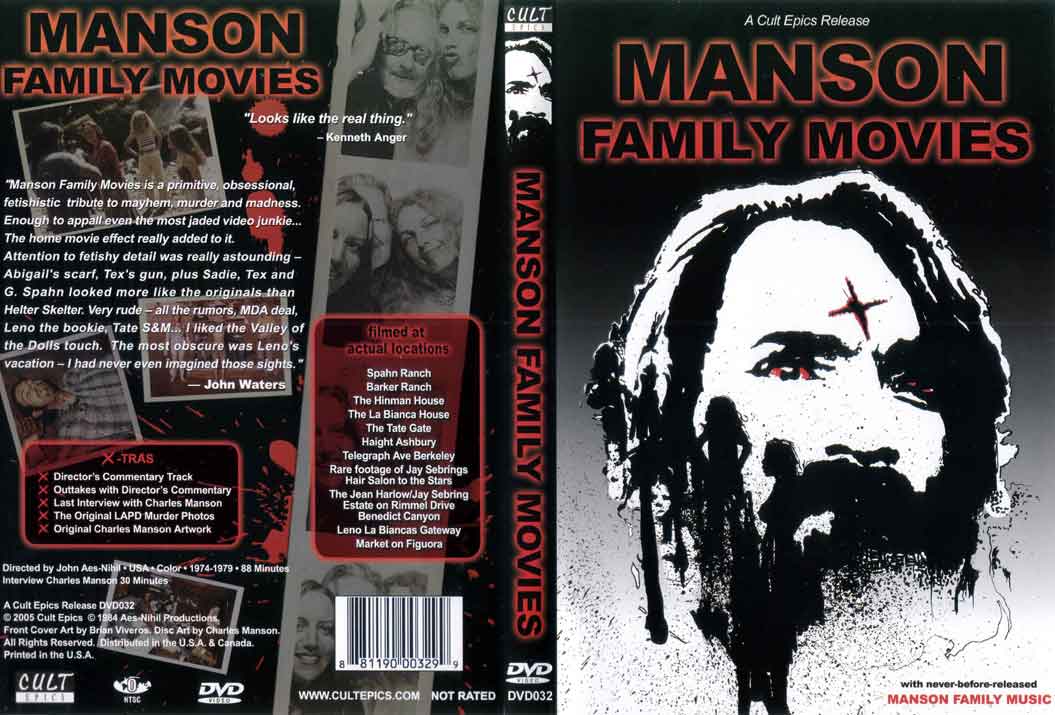
The killings attributed to the Manson Family are, in their essence, no different than crimes that happened on a daily basis in the 1960's. Though gruesome, multiple homicides and even serial murder were not new concepts at the time. Why, then, did these particular crimes capture America's attention to such a degree? Much like it's films, Hollywood's most famous murders were tailored perfectly for public consumption. The most well known victim, Sharon Tate, was a beautiful young starlet. Playing opposite her as the villain was Charles Manson, a larger-than-life character that seemed to embody the worst aspects of the permissive sixties culture. Conservative America was distrustful of the youth movement, and Charles Manson's very existence confirmed all of their fears. Many have attempted to bring the killings to the screen with varying degrees of success. John Aes-Nihil's MANSON FAMILY MOVIES brings a fresh perspective to this familiar topic.
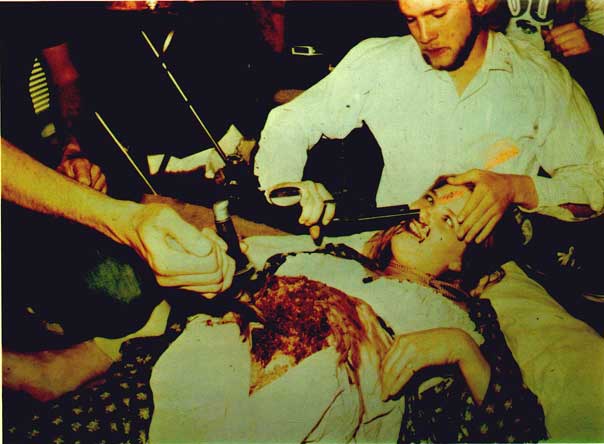
MANSON FAMILY MOVIES is structured to resemble just that: home movies shot by members of the Manson Family. Working without dialogue, Aes-Nihil attempts to bring a narrative structure to a collage of images that are both graphic and disorienting at times. The viewers are taken through key events in the Manson Family's history. Additionally, the omniscient camera also shows the victims prior to the murders. Aes-Nihil uses a blend of concrete facts (to which he brings a high level of detail) and urban legends surrounding the crime, which are shown in gloriously exploitive sequences.
The lack of dialogue is going to be the main stumbling block for most viewers. In lieu of dialogue, Aes-Nihil will occasionally use crudely drawn title cards to convey character's speech. The film is not silent, however, the soundtrack is compiled from the recordings of Manson and his Family members, lending a macabre authenticity to the proceedings. The lack of dialogue creates a problem for viewers unfamiliar with some of the subtle details of the case. This is clearly a film for devotees of the crime, as an intimate knowledge of it is all but required to follow the film closely.
Although it shows the Family and their crimes in great detail, MANSON FAMILY MOVIES does not glorify them. By using the "home video" format, Aes-Nihil is presenting the Family's activities as part of the collective memories of a nation. Just as your trip to the beach when you were nine is a part of your memory and an event that shaped your life, the Manson Family murders are part of the memory of America. It's an event that seems less than real now, like a movie you've seen in the past. Aes-Nihil's film shows the murders as an event that transcends a mere crime story and instead a crucial event in shaping society after the sixties. - Film Fanaddict-David Carter 2006
Manson Family Movies
A recreation thereof–25th Anniversary
Edition (70 min.), featuring new soundtrack with never-before-heard
Manson Family Music.
"Manson Family Movies
is a primitive, obsessional, fetishistic tribute to mayhem,
murder and madness. Enough to appall even the most jaded
VCR junkie... The home movie effect really added to it.
Attention to fetishy detail was really astounding–Abigail's scarf, Tex's gun, plus
Sadie, Tex and G. Spahn looked more like the originals than
Helter Skelter. Very rude–all the rumors, MDA deal, Leno
the bookie, Tate S& M... I liked the Valley of the
Dolls and Nico touch. The most obscure was Leno's vacation–I had never even imagined those
sights."– John Waters
------------
Almost Feels Like the Real Thing, 14 December 2008
Author: Rapeman from New Zealand
In the summer of '69 members of Charlie Manson's "family" stole an NBC-TV truck loaded with film equipment. Later on the truck was dumped and the majority of its contents given away, but Charlie kept one of the cameras. The Family also allegedly owned three Super-8 cameras which they used to produce amateur porn films. Based on this information and an interview with a one-time member of The Family which (rather vaguely) supports this, Ed Sanders speculates in his book The Family, that Charlie and his followers may have filmed their crimes and/or been involved in the production of "snuff films". This was the first recorded use of the term snuff.
With Manson Family Movies John Aes-Nihil has taken this material combined with the rumour that The Family also filmed re-enactments of their murders and produced a chillingly accurate portrayal of what these films may have been like.
The film opens with Charlie's introduction to, then seduction of Sadie-Mae then cuts to some authentic street scenes on Haight-Ashbury complete with half naked stoned hippies, blacks being arrested, crazed homeless folk with Charlie in the middle of it all rapping with / recruiting some of his girls. For the next forty or so minutes we are witnesses to The Family going about their everyday activities and the events leading up to the Tate / LaBianca murders: drug-fuelled orgies, naked fire dancing, mock crucifixions of Charlie, creepy crawl missions, group listenings of The White Album, an unsettling gangbang with ol' George Spahn and the drug-deal-gone-bad scenario.
The second half of the film covers the murders. It seems kind of pointless to go into details here as I'm sure the majority of you reading this are well aware of the grisly facts. Suffice to say Sharon's murder and subsequent "abortion" are particularly meaty.
Family Movies was shot on scratchy 8mm film stock and is silent aside from the soundtrack which is a combination of Charlie's music, Aes-Nihil's band Beyond Joy and Evil which is of a similar folksy tone to Charlie's, and avant-garde electronics, backward voice loops & squealing sax during the more atmospheric parts. The film was shot a mere few years after the murders and uses all of the exact locations where the events happened. Aes-Nihil's dedication and meticulous attention to detail here is beyond obsessive, right down to the precise spot where they dumped their bloody clothes after the Tate murders.
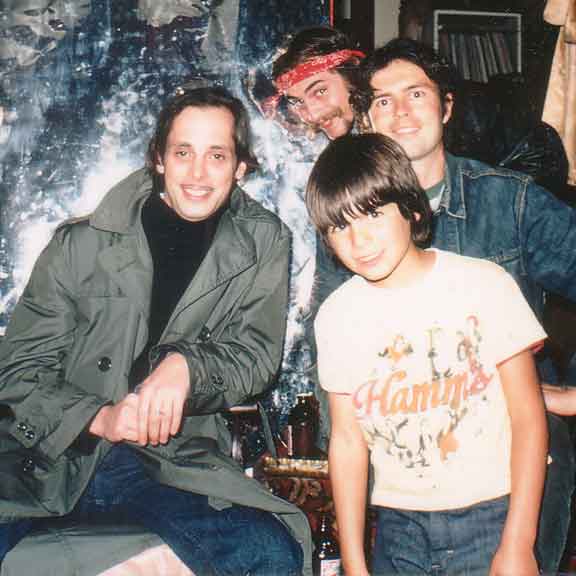
The gritty home movie quality coupled with the flawless soundtrack adds so much realism to the film that it almost looks and feels like the real thing. Part of this feeling of authenticity is also due to the fact that the cast is made up of a rag-tag bunch of Aes-Nihil's hippie friends and people literally pulled off the street, some of whom were acquaintances of The Family - one of the actresses playing Squeaky pulled out of the film after shooting a few scenes because her apartment burned down and she suspected it was retaliation from Family members for starring in the film.
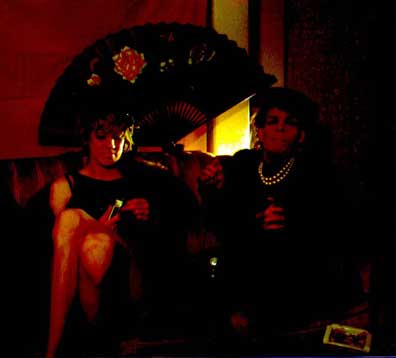
Seeing as the film is shot from the point-of-view of The Family recreating their crimes there is a sense of comedy here too - some members play two or three characters which infrequently leads to them being in drag, oftentimes the cast struggle to keep a straight face, particularly during the murder scenes, there are recurring in-jokes like Sharon Tate's black maid constantly reading Nietzsche, an amusing nod to Valley of the Dolls and a hilarious moment during Tate's prolonged murder scene when a discordant punk song suddenly erupts on the soundtrack entitled Die Bitch (courtesy of the Sloppy Titty Freaks). Also, in the commentary track the director notes the "actor" playing George Spahn was a seventy-year-old ex-art critic who was tripping on LSD for the first time.
All in all I can honestly say Manson Family Movies is the most authentic-looking and therefore enjoyable film I've seen concerning the "legacy" of Charles Manson and his Family. It's obvious this was a highly personal project for John Aes-Nihil and all his care and attention to even the smallest of details definitely pays off
"Looks like the real thing."–Kenneth
Anger
"I remember your film very well and it looked SCARY! It
had an authentic feel to it that made us squirm. Well, it
looked gritty and homespun and made me NERVOUS. Keep up
the original and disturbing atmosphere."–George Kuchar
"Aes-Nihil Productions recreates the apocryphal Manson home
movies darkly hinted at in Sanders’ The Family. Filmed almost
entirely at authentic locations."–Tuxedo and Pinky, Masters of
the Final Solution
"Aes-Nihil’s Manson Family Movies
is to Manson what Deranged is to Ed Gein, with all its grotesque
splendor. Any Manson fan is getting more than they bargained
for."–Mussette
and Yehti, Authorities on The End Times
"Manson Family Movies
will remind you of your earliest breakdown... of a time
when even the Good Humour man could whip out his peter and
force it down your quivering young throat. With the kind
of spontaneity that everyone just loves, this chilling comedy
poked fun at ritualistic human slaughter, along with the
accompanying seizures of catatonic psychosis. More than
just a documentary, Manson Family Movies
boasts an effervescent instability reminiscent of those
films they used to show you in elementary school about going
to the dentist. So caress yourself without remorse, the
time has come to abandon your inhibitions!"–Alex St.
Ives, Pornographer
"Undoubtedly, if Jim Van Bebber’s The Manson Family (2003) is the greatest, most aesthetically ambitious, and psychedelic-driven Manson-themed movie ever made, Manson Family Movies (1984) directed by self-proclaimed ‘aesthetic nihilist’ John Aes-Nihil (The Goddess Bunny Channels Shakespeare, The Drift) is the most obsessive, gritty, pathologically tasteless, and historically accurate (anti)tribute to the dirty derelict deeds of the hillbilly hobo antichrist and his fucked family of fallen bourgeois degenerates. Indeed, while occult guru Nikolas Schreck’s documentary Charles Manson Superstar (1989) probably provides the best and most objective look at Manson Christ and his crazy gals, Manson Family Movies is the most aggressively visceral and vicious look at the sordid story and thus makes for singular viewing (dis)pleasure that simultaneously manages to both trivialize the bloody beatnik events and aesthetically terrorize the viewer in an uncompromising fashion that one would expect from a mad man. Inspired by the supposed urban legend that Manson and his acidfreak pseudo-family had actually filmed their aberrant activities and even went so far as creating the murders for posterity, Manson Family Movies is an innately morally retarded no-budget piece of pathetically provocative celluloid shit that was shot on consumer grade 8mm film stock so as to give it an audaciously authentic essence as if one of the family members was sober enough to keep a camera rolling as the rest of the gang partied homicidally hard. Indeed, shot silently and featuring not a single line of audible dialogue, Manson Family Movies certainly feels like a home movie from hyper-hedonistic hippie hell and a work that seems like it was filmed by a spastic speed addict for his own aimless brain dead amusement. Described by cine-magician Kenneth Anger, who was once a mentor of sorts to Manson associate/killer Bobby Beausoleil (who starred in Anger’s Invocation of My Demon Brother (1969) and scored Lucifer Rising (1972) while in prison), with the highly flattering compliment that it, “Looks like the real thing,” Manson Family Movies is undoubtedly the delightfully dubious expression of a fellow with a rather foul Manson obsession. Probably the most ambitious and oddly obsessive cinematic attempt to recreate an infamous true crime case, Manson Family Movies was shot at the actual locations of the events leading up to, and including, the flower-power-exterminating Tate-LaBianca murders (including the very spot where the hippie killer dropped the bloody clothing of Sharon Tate and her fellow victims). A mischievously merry and wantonly witchy Mansonite jamboree movie, Manson Family Movies features gay negro drag queen maids reading Nietzsche, three different (non)actresses playing Susan Atkins aka Sadie Mae Glutz, degenerate hippie bastards in Nazi helmets sieg heiling the police, and a hip and happening neo-völkisch hillbilly folk soundtrack by Mr. Alpha-Anti-Hippie himself; Charles Manson.
As anti-aesthetic auteur John Aes-Nihil revealed in the audio commentary for the Cult Epics dvd release of Manson Family Movies, Charles Manson was played by a strange fellow (‘Rick the Precious Dove’) who had the dignified distinction of being an ex-Green Beret, five foot two, half Mexican/half German by ancestry, and apparently being “rather psychotic.” Interestingly, it is rumored that the real Charles Manson was the bastard son of a mulatto, but I digress because whatever the real racial stock of Mr. Manson, micro Mestizo-Kraut ‘Rick the Precious Dove’ certainly can pass for the crazed cult leader, even if he is a slight bit more swarthy than the real man. Opening with Manson strumming his guitar and subsequently carnally manhandling Sadie Mae Glutz, Manson Family Movies ultimately takes an abridged fragmented approach to cinematically telling the torrid tale of the life and times of the Manson Family. Hanging out at Spahn ranch, one of the mad Manson girls receives cunnlingus (Aes-Nihil claims this scene was totally unsimulated) from the rather voracious ranch owner George Spahn (played by ‘Palmo’) in a less than pretty quasi-pornographic scene. Of course, Lucifer-like Manson associate Bobby Beausoleil (‘Porn Michael’) and a couple of the gals pay a visit to hippie teacher/dope Gary Hinman and torture him for a couple days because he purportedly sold them bad acid. Being a deluded Zen Buddhist, homo hippie Hinman does not even put up a fight and even goes so far as peacefully handing a weapon to one of his deranged torturers. Manson also pays a visit to the Hinman home and cuts the drug dealer’s ear with a sword. After Beausoleil wastes Hinman, the Manson girls write “Political piggy” on the wall to make it seem like the Black Panthers committed the murder. Meanwhile, a black tranny maid (The Cosmic Ray) religiously reads from Friedrich Nietzsche’s posthumously released tome The Will to Power and carefully dusts a LP soundtrack for Valley of the Dolls (1967) starring Sharon Tate. Indeed, the black tranny is Tate’s maid and the shemale spade also force-reads excerpts of The Will to Power to the bimbo-like babe as if her life depends on it. Of course, the Manson family eventually pays an unexpected visit to the Tate-Polanski home and they slaughter all the inhabitants of the house, but not before making macabre jokes about the fact the actress is pregnant and her baby will die a violent death as well. In what is easily the most artful and transcendental scene of Manson Family Movies, Charlie is lovingly crucified by his family in a scene rivaling the campy crucifixion from The Devils (1971) directed by Ken Russell. In the final scene of Manson Family Movies in a sardonic scenario auteur Aes-Nihil proudly described as “a moment of devout cynicism,” three members of the family throw away the gigantic crucifix that Charlie was previously hanging from into a park trashcan. Quite fittingly, Manson Family Movies concludes with the 1970 Charlie quote, “It wasn’t my children who came at you with guns and knives, it was your children,” thus demonstrating Aes-Nihil's sheer and utter contempt for the American mainstream.
Featuring nil dialogue, upwards of three amateur actors playing a single character (thus making it nearly impossible to discern who is who during various scenes), a horribly homely and overweight Sharon Tate smiling as she is violently stabbed in her fetus-filled stomach, unsexy unsimulated sex featuring elderly men on LSD, a sassy negro tranny with a nasty Nietzsche obsession, bargain bin blasphemy of the culture-less American sort, and happy-go-lucky ultra-violence of the totally unbelievable variety, Manson Family Movies is certainly a film that epitomizes the phrase “trash cinema,” so it should be so no surprise that the ‘Pope of Trash’ himself, John Waters, stated of the film: “Manson Family Movies is a primitive, obsessional, fetishistic tribute to mayhem, murder and madness. Enough to appall even the most jaded VCR junkie... The home movie effect really added to it. Attention to fetishy detail was really astounding—Abigail’s scarf, Tex's gun, plus Sadie, Tex and G. Spahn looked more like the originals than Helter Skelter. Very rude—all the rumors, MDA deal, Leno the bookie, Tate S&M... I liked the Valley of the Dolls and Nico touch. The most obscure was Leno's vacation—I had never even imagined those sights.” Indeed, for those with little knowledge and/or interest in the Manson Family and their macabre misadventures, Manson Family Movies will probably prove to be the most brazenly banal, badly directed, and patently pointless film ever made, but for the already initiated, Aes-Nihil’s Mansonite fetish flick is a tastelessly tasty treasure trove of serial killer-like pathological obsession and homicidal hillbilly aesthetic majesty.
For those familiar with Manson’s oftentimes dark and intensely idiosyncratic folk music, Manson Family Movies plays like a genuine Mansonite musical. Also featuring music by director Aes-Nihil’s band Beyond Joy and Evil, The Beatles (namely “Helter Skelter”), Patty Duke’s theme from Valley of the Dolls, Richard Wagner’s “Liebestod,” and a couple random punk tracks, Manson Family Movies—a whimsical work erratically synthesizing cultural ingredients from both high and low culture—is certainly a putrid piece of celluloid ‘aesthetic nihilism’ directed by an auteur who personifies being a ‘degenerate’ in the truest Nordau-esque meaning of the word. In addition to receiving critical acclaim from such great queer auteur filmmakers as Kenneth Anger and John Waters, Manson Family Movies also received perverse praise from unhinged underground filmmaker George Kuchar, who stated personally to director Aes-Nihil, “I remember your film very well and it looked SCARY! It had an authentic feel to it that made us squirm. Well, it looked gritty and homespun and made me NERVOUS. Keep up the original and disturbing atmosphere.” A sort of misbegotten movie marriage between Roger Watkin’s Manson-inspired flick The Last House on Dead End Street (1977) meets the audaciously amateurish art-trash of Harmony Korine’s Trash Humpers (2009), Manson Family Movies certainly makes for a great, if not one-sided, date with the celluloid gutter. For those that enjoyed Manson Family Movies, contemporary punk artist Raymond Pettibon’s somewhat inferior shot-on-VHS epic of lo-fi video-art-filth The Book of Manson (1989) also makes for mandatory viewing. A sub-cult classic of the crazed campy sort, Manson Family Movies—in its outstanding aesthetic ineptitude, innate immorality, and general narrative incoherence—is ultimately a reminder why there will probably never be a definitive Manson family movie as Hollywood will never touch the subject in a serious and sincere manner and those genuine underground auteur filmmakers that are willing to dive deep in the world of Helter Skelter lack the sanity, budget, and production values to execute it properly."–Ty E, soiledsinema.com
The Drift
The latest high drama from Aes-Nihil–starring
Glen Meadmore, The Goddess Bunny, The Cosmic Daniel, Michael
Kleats, Tom T.O.P.Y., Paula P-Orridge and Lance Loud.
"The Drift is really quite hypnotic
and riveting. It's hard not to see the whole thing in one
sitting but once your caught in that web of decorated decadence
it's impossiable to budge the buttocks toward more sacharine
seating. George Kuchar
Much as VINYL appears to be closer to the novel on which
it is based than does the Hollywood version of, so THE DRIFT
strikes is as more to the point of Tennessee Williams' novel
THE ROMAN SPRING OF MRS. STONE than does the Tinseltown
version. And the latter is no mean competiotion for as you
may remeber it stars Vivein Leigh, a very young Warrne Beautty,
and the redoubtable Lotte Lenya. But what that book is really
about or what it really is is not something Hollywood can
put its finger on easily. For it is not about the deparavity
of its own viewpoint and vision. This Aes-Nihil captures
admirably. And with a fraction of the effort that went into
the commercial venture. What is most elusive about THE DRIFT
and perhaps it is the secret to what makes it work is that
we are never certain of Aes-Nihil's conscious intentions.
But then again neither are we ever really certain of Mae
West's. What we can be sure of is their sucess. From the
moment that we gaze down the 'spanish Steps' at young Paolo,
gaze down through the lectherous eyes of our tranvestite
matron the not-to-bebroken concentration of her eyes we
know we are in sure hands. They they understood what this
truly sordid tale is all about. And just who is sordid in
the whole undertaking. What I,m saying is that Tennessee
Williams was never more roundly denounced than he is by
THE DRIFT and that that denuciation may be coming from a
fan. And that is the work's secret. And where in the world
could one have come up wit a better Countessa than we have
in Goddess Bunny? Especically if you felt you had to oudo
and out perform Lotte? We are talkingdepravity that takes
the luncheon lobster right out of Lotte's yawning maw. THE
DRIFT understands the signifance of all the stars in this
work and what it comes up is breathtaking. Every setting
as it relates both the book and commercial flick is hilareous.
And Michael Kleats as Paulo is making a statemnt on Paulos
the world over that needs no elaberation. Above all the
films keeps its sence of good humour about it. The actors
appear to be enjoying themselves and since they are so are
we. The pay off comes when one of them gets truly picked
off for we get to witness something rarely captured captured
on the screen: A queen's true fury. And all the while we
are watching Mr. Williams' yarn."–Ronald Tavel,
Feburary 1997
"The Drift is a complete travesty... an obscene and
tantalizing tragedy best suited to those whose existence
lies cradled in the sweaty arms of misery. Never before
can I recall when so many unhealthy elements have merged
to form something such as this: a concentrated miasma of
murdered desire and cultivated despondence. This is the
story of an arrogant woman and the men forced to endure
her neurosis. She’s a wreck: in the course of her life,
she periodically flirts with sensitivity only to have her
obsession with poverty inflate so dramatically that it suffocates
her simple dream of being a farmer’s wife. The Drift
illustrates a world of too much etiquette, just enough silverware,
and not nearly enough champagne!"–Alex St. Ives, Pornographer
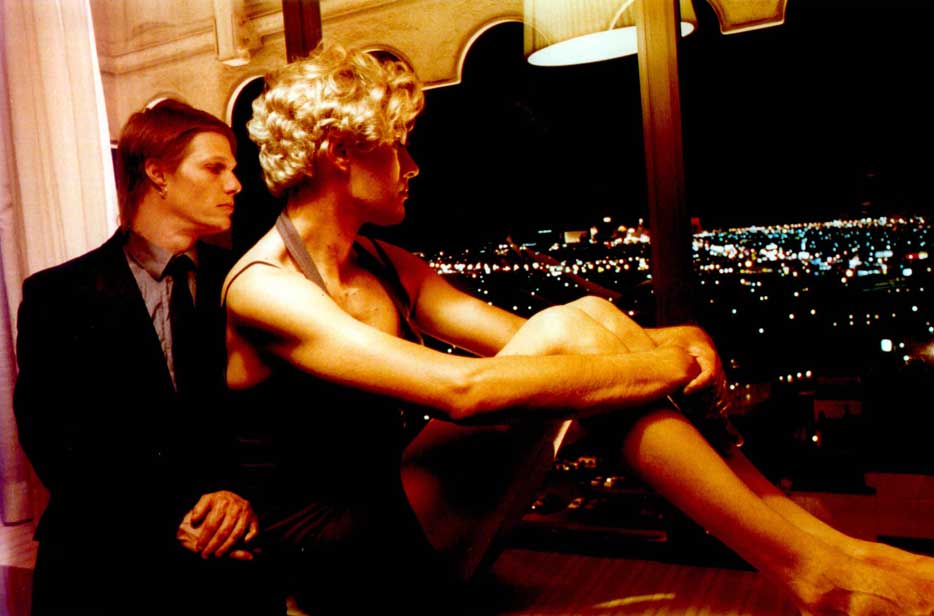
Although I cannot say I have read a single word written by southern sodomite playwright Tennessee Williams, I don’t think I have ever seen a bad film adapted from one of his works and I say that as someone who hates old school Hollywood as much as contemporary Hollywood. Needless to say, I was quite glad to discover that self-described ‘aesthetic nihilist’, archivist, and auteur John Aes-Nihil (Manson Family Movies, The Goddess Bunny Channels Shakespeare) adapted two of Williams’ plays in acutely aberrant art-trash hysterical-camp form, which include The Drift (1989) and Suddenly Last Summer (2008). While Suddenly Last Summer is a sort of iconoclastic ‘anti-remake’ of Joseph Mankiewicz’s 1959 Tennessee Williams’ adaptation of the same name, The Drift is a take on the playwright’s less revered first novel The Roman Spring of Mrs. Stone (1950), which was also adapted by José Quintero in 1961 as a British production starring Vivien Leigh and a rather young Warren Beatty and later adapted in 2003 by Robert Allan Ackerman as a TV movie starring Helen Mirren and Anne Bancroft. Needless to say, with its combination of paraplegic, Amazonian, and Latino trannies, as well as no-budget camcorder aesthetic and classical European architecture, The Drift is easily the most innately absurdist, aesthetically repugnant, and melodramatically preposterous take on a Tennessee Williams work that I have ever seen. Indeed, not unlike the late great German Renaissance man Christoph Schlingensief’s film Mutters Maske (1988) aka Mother’s Mask—a radically ridiculous ‘freeform’ remake of Veit Harlan’s classic high-camp National Socialist melodrama Opfergang (1944) aka The Great Sacrifice that takes the conventions of high drama and throws them through a sadistic scatological celluloid blender—The Drift is a savory yet sickening sardonic take on Williams’ novel that wastes no time in deconstructing and debasing the ‘cryptic’ gay subtexts of its source material. Like the work of Tennessee Williams as molested by Paul Morrissey’s Women in Revolt (1971), John Waters’ Polyester (1981), and Leni Riefenstahl’s Olympia (1938), The Drift seems like the result of what an elderly old rich Anglophile with dementia who used to be a fan of the so-called ‘Woman’s Film’ might visualize as her brain rots away in a multicultural old folks home. A decidedly deranged depiction of demented man-divas of the physically and emotionally misbegotten sort, The Drift is the sickly sassy tale of a famous theater star who quits acting for her billionaire industrialist hubby, only for said billionaire industrialist hubby to die shortly after and leave her a widow and the prey of her scheming shebitch friends. A divinely nightmarish and nihilistic work from the apocalyptic aristocratic gutter, The Drift depicts everything that is repellant about the bombastic bourgeois bitches, albeit portrayed by poor tranny proletarians.
After giving up her dead serious career in theater, Karen Stone (portrayed by gay Christian punk musician Glen Meadmore, the foremost proponent of cocksucking ‘cowpunk’) also loses her stinking rich billionaire industrialist husband to a heart attack and thus loses everything she has aside from, of course, her giant fortune. Deciding to stay in the ancient European paradise that is Rome, Mrs. Stone has no idea that her life will ultimately take a tragic turn for the worse after becoming the more than willing pawn of a male prostitute puppet and his tranny pimp puppet-master. While Mrs. Stone has self-deluded herself enough to believe she really loved her dead hubby, her best friend Meg Bishop (Daniel Hernandez aka ‘Cosmic Danielle’) believes otherwise and has no problem matter-of-factly stating to her friend, “Oh, you can’t fool me darling…You can’t tell me you love that fat little porky man with the little penis…You loved his money. You can’t fool me. We have been friends far too long, darling.” Meanwhile, enter the queen bitch madam ‘The Countessa’ (portrayed by the ever elegant and the one-and-only, ‘The Goddess Bunny’ in what is his most elegant role). A ‘matchmaker’ in the most wickedly Weiningerian sense, the Countessa has a sinister talent for hooking up young ambiguously gay gigolos with lonely wealthy old widows. Needless to say, Mrs. Stone becomes the Countessa’s latest victim, or as Meg states, “romance…that dreaded disease…rears its ugly head in the form of that dreaded Countessa.” When the first male hustler attempts to ask for money under the dubious pretense that it is for his friend’s kid with multiple sclerosis, Mrs. Stone becomes exceedingly offended and states, “How dare you! I have never ever been so insulted.” When Meg encourages Mrs. Stone to get back into acting, the widow acknowledges she was a non-talent hack actor, to which her friend cleverly replies, “Talent is merely the ability to pull wool over somebody’s eyes.” Of course, Mrs. Stone is nowhere near as talented of an actor as a handsome hustler named Paulo (Michael Kleats), who makes the lonely widow fall under his spell. While Meg warns her friend, “Darling, I simply must tell you, you’ve got to be careful. I mean, scandal can ruin a name and in this town it will drive you down faster than the Titanic,” Mrs. Stone has already been touched by the kiss of death that is love. As the Countessa sinisterly confesses, “To have something on Mrs. Stone is my ultimate number #1 thrill” and, indeed, with the help of her underling Paulo, she manages to get pornographic footage of Mrs. Stone and her bought beau, which is projected at a tea party hosted by the hostile madam. On top of that, Paulo cheats on Mrs. Stone with another woman (portrayed by Paula P-Orridge, the ex-wife/baby-mamma of tranny aesthetic terrorist Genesis P-Orridge). Pathologically lovelorn and suffering from the worse fate a woman can meet, a ruined reputation, Mrs. Smith wanders around the European countryside like a ghost searching vainly for some sort of intangible love. In the end, Mrs. Stone enters a villa (in a scene which was actually shot at the Los Angeles Movie Palace on Broadway) and a gunshot is heard shortly after, but like Rainer Werner Fassbinder’s Chinese Roulette (1976), it is left up to the viewer’s imagination as to who was actually shot.
With the possible exception of Suddenly Last Summer, The Drift has to be auteur John Aes-Nihil’s most infectiously campy work to date. Described by pioneering lo-fi queer auteur George Kuchar (The Devil’s Cleavage, Symphony for a Sinner) as being “really quite hypnotic and riveting. It's hard not to see the whole thing in one sitting but once you're caught in that web of decorated decadence it's impossible to budge the buttocks toward more saccharine seating,” The Drift is certainly the cinematic equivalent of a sleazy mass market romantic page-turner as found in the porn collection of Werner Schroeter. Starring a humungous he-heroine who is literally twice the height of her friends and two real-life rivals, the Goddess Bunny and the Cosmic Danielle aka Cosmic Daniel, playing cinematic rivals, The Drift is undeniably equipped with an unhinged universe that delicately defiles the viewer’s soul with egomaniacal tranny glamour. Featuring exquisitely delivered jokes about lesbo-on-lesbo rape, crack-addled paraplegic welfare receipts portrayed by cunning yet cultivated aristocrats and Hispanic trannies portraying gay twink-loving German barons (Cosmic Danielle plays a second role as a character named ‘Baron Waldheim’), preposterously pompous anti-American micro-tirades (“Americans, trash trash”), cultivated goombah-bashing (“Not all Italians are dirty filthy things”), and classical European music and architecture, The Drift is a hysterical hodgepodge of the aesthetically high and low but always camp and uniquely underground. Interestingly, The Drift was once screened at the Provincetown Tennessee Williams Theater Festival in Massachusetts. That being said, my only complaint regarding The Drift is I will never get to hear Tennessee Williams' thoughts on the film. — SoiledSinema.com
Whilst Filming The Drift,
The Goddess Bunny Channels Shakespeare
Starring The Goddess Bunny, Glen
Meadmore, That Cosmic Daniel and a hustler.
"The entertaining Goddess Bunny sops up another one in this,
the finest and most frequently requested video in our catalog. The Goddess Bunny Channels Shakespeare dismembers all notions of decency
with the timely story of a conceited whore starlet dedicated
to the complete annihilation of Hollywood glam hypocrisy.
While liquor bottles clatter repeatedly under the sofa,
the Goddess Bunny continues her oration in the gloriously
slurred voice of popular Elizabethan playwright, William
Shakespeare. While cries of euphoria echo throughout the
auditorium, the Goddess succumbs to her terminal ache of
elegance, and climaxes by re-writing the dictionary and
simultaneously begging for death."–Alex St. Ives, Pornographer
The Goddess
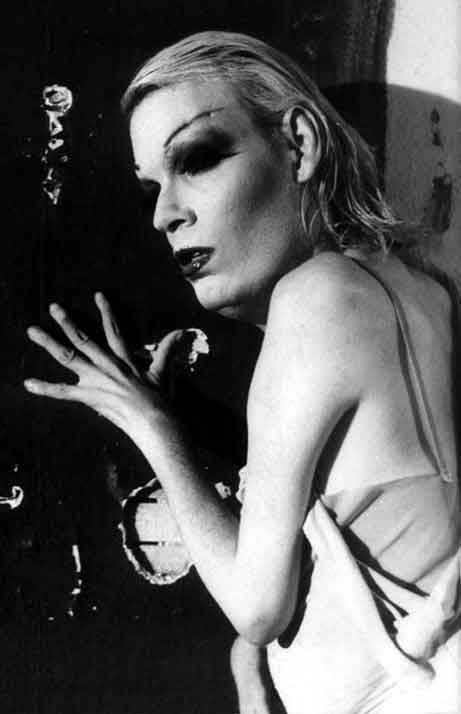
Bunny: The Only Truly Glamorous Star Left In Hollywood
Also, the only transsexual/ex-quadriplegic/ex-hooker/drag
queen, period. Includes the infamous Tap Dance, Hollywood
Girls, Hollywood Vice and live shows in Hollywood. Sorry,
no porno!
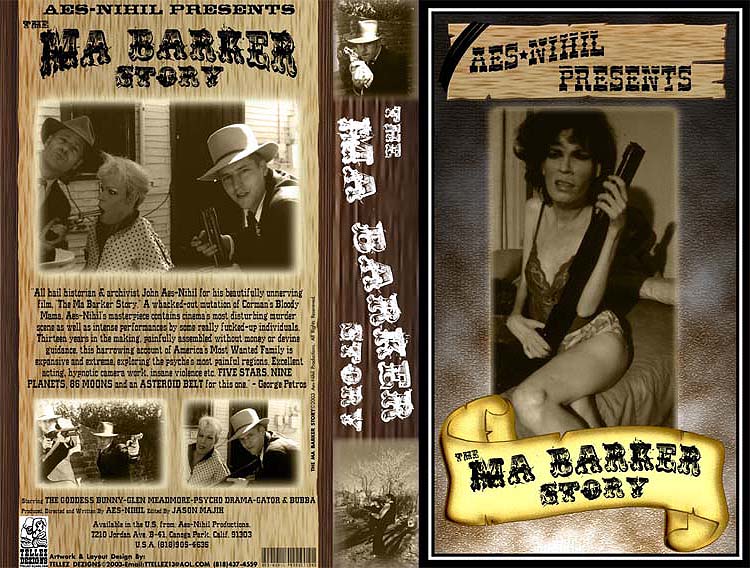
The Ma
Barker Story
A musical comedy based on the
day to day life of the notorious 1930s Barker Gang. Filmed
on location at the Barker Ranch, the Spahn Ranch and in
downtown Trona. Starring the Goddess Bunny as Ma Barker,
Brett and Bubba of Psycho-Drama as Herman and Freddie Barker,
Glen Meadmore as Alvin Karpis, X-Tina as Rembrandt and Harlan
as Pa Barker.
"The murder is too real!"–Don Murphy
-----------
All
hail historian and archivist John Aes-Nihil for his beautifully
unnerving film The Ma Barker Story. A whacked-out
mutation of Corman's Bloody Mama, Aes-Nihil's masterpiece
contains cinema's most disturbing murder scene, as well
as intense performances by some really fucked up individuals.Thirteen
years in the making, painfully assembled without money or
divine guidance, this harrowing account of America's Most
Wanted Family is expansive and extreme, exploring the psyche's
most painful regions. Excellent acting, hypnotic camera
work, insane violence, etc. FIVE STARS, NINE PLANETS, 86
MOONS and an ASTEROID BELT for this one."–George Petros
------------
"Andy Warhol may be dead but he
must be clapping from on high over John Aes-Nihil’s latest
pairing with the divine Goddess Bunny in this outing that
maybe continues the paths explored in Lonesome Cowboys,
or at least charts a direction The Shaggs may have taken
if they were homosexual paraplegics on LSD. The garbage
dumpsters of Southern California appear to be overflowing
as Aes-Nihil has merely dusted the tops of the refuse to
populate his latest pioneering adventure, a toiled and unwashed
milieu of decadence, murder, rape and the deconstruction
of the Western adventure. With an overly wavering camera
eye, subdued sound recording complete with obscuring winds,
and a dirt-covered set that suspiciously resembles my mind’s-eye
illusion of the Spahn Ranch in its Manson-overrun heyday,
Ma Barker obliterates preconceived notions of what
a film is, and gives us... this."–Shade Rupe
------------
From the Pope of Aesthetic Nihilism himself - Jon Aes-Nihil - comes this bizarre reimagining of the Karpis-Barker gang saga. This family/gang of criminals terrorized the Midwest with a series of bank robberies, kidnappings and murders in the 1930s.
The Ma Barker Story is essentially a prequel to Aes-Nihil’s 1984 film Manson Family Movies, as linked by a historical connection between a young Charlie Manson and Alvin “Creepy” Karpis. It seems when Charlie was locked up as a youngster in the early ‘60s, Creepy took him under his wing and taught him to play the guitar.
Starring lovable transsexual-quadriplegic-drag queen the Goddess Bunny as Ma Barker and queer Christian cow-punk Glen Meadmore as Alvin “Creepy” Karpis, The Ma Barker Story depicts a week (or so) in the life of the notorious gang.
"An absolute must-see for lovers of transgressive cinema "
If this film is to be believed, a typical week for the gang involves: hanging out on the porch of their ranch gettin’ tore up on moonshine; committing a rape/murder; robbing a bank; chowin’ down on some greasy lard sandwiches; then executing the local Sheriff for sleeping with their beloved Ma. A very full week indeed!
Shot on location at the Barker and Spahn Ranches and inspired by Roger Corman’s Bloody Mama, Aes-Nihil presents a deviant vision of the wild west laced with drunken transgressions and quadriplegic sex acts. The Goddess Bunny is superb as the Barker matriarch, waving her shotgun around at random and egging her boys on. She even has a somewhat touching scene with her aged mother who gives a heartfelt plea for daughter to go on the straight and narrow.
"brings to mind the early films of auteurs such as Andy Warhol, John Waters and the Kuchar Brothers"
Aside from Ms. Bunny’s Oscar deserving performance, honourable mentions must go to Glen Meadmore as the guitar-strumming Alvin Karpis and Bubba as the Opium-addicted Freddy Barker, both pull off some truly memorable and often hilarious “acting”. Most unforgettable quote undoubtedly goes to Gator as Herman Barker who, in reference to Ma kicking Pa out of the domestic bed in favour of the Sheriff, utters: “A Pa must have a beard and that Sheriff ain’t got no beard!”
The whole atmosphere of the film feels very much like a fucked-up home video, e.g - a bunch of friends get off their tits and decide to break out the camera and indulge in some play-acting. This is not a negative point in my opinion as it brings to mind the early films of auteurs such as Andy Warhol, John Waters and the Kuchar Brothers.
The soundtrack deserves a mention here too as it is really what pulls the whole thing together: the film opens with a scene of the Barker boys in jail underscored with Clang Bang Clang by Charlie Manson; from then on it is pretty much Meadmore’s “Christian-Country-Punk” tunes and some banjo noodling that fill the score. Particularly in the final scenes the melancholic country songs coalesce with the onscreen goings-on to make it all that much more powerful.
An absolute must-see for lovers of transgressive cinema and/or Waters, Warhol & Kuchar fans - Rapeman
------------
In a review of the campy true crime exploitation flick The Ma Barker Story (1990) directed by preternatural historian, aesthetic nihilist archivist, and aberrant-garde auteur John Aes-Nihil (Suddenly Last Summer, The Drift), underground art designer/journalist/artist/editor George Petros (EXIT magazine (1984-1992), Propaganda magazine (1982-2002)) rightly described the sub-underground film as a “whacked-out mutation of Corman’s Bloody Mama.” Indeed, The Ma Barker Story is like Bloody Mama (1970) as remade by the psychopathic Mansonite stepbrother of Paul Morrissey (Flesh, Women in Revolt) and Andy Milligan (Vapors, The Body Beneath) as an appetizingly tasteless and spiritually sick piece of morbidly melodramatic high-camp aesthetic nihilism of the hysterically hilarious sort. Made over a 13-year period and shot with a consumer grade camcorder in an innately cockeyed fashion as if seen from the perspective of a sadomasochistic voyeur who has no intention of reporting the crimes he witnessed to the cops, The Ma Barker Story quite consciously transcends Bloody Mama in terms of taking sensational (but surely not sensual!) artistic liberties regarding the facts relating to the point of the real-life Barker-Karpis gang—a quasi-incestous gang from the Depression era spanning from 1931 to 1935 that is probably best known today for being ostensibly led by the mother of its leaders—and thus reduces the true story it is based on to the level of a decidedly debauched white trash homevideo soap opera. A sort of thematic and aesthetic prequel to Aes-Nihil’s first feature Manson Family Movies (1984) due to the fact that Barker gang leader Alvin ‘Creepy’ Karpis acted as a father figure for Charles Manson while the two were imprisoned at Alcatraz federal penitentiary and even taught the younger career criminal how to play guitar, The Ma Barker Story also has the rather refined distinction of featuring original cracker folk music by Manson himself. Also, like Manson Family Movies, The Ma Barker Story was also partly filmed at the Spahn Ranch (as well as Barker Ranch) where the so-called Manson Family lived and engaged in lecherous LSD-fueled orgies. A truly fucked folk flick and a sort of American tragicomedic equivalent to the ‘anti-Heimat’ of German New Cinema during the late-1960s/early-1970s that is set in the homicidal heart of sunny Southern California, The Ma Barker Story is nothing if not a scrumptiously unsavory slice of Americana that has the gall to celebrate America’s timeless tradition of pioneer-style ultra-violence and criminality.
Beginning at Alcatraz with the classically melodic yet strangely melancholy Manson tune “Big Iron Door,” The Ma Barker Story soon cuts to the Barker Ranch and the viewer is treated to a one week day-in-the-lives musical-melodrama-western hybrid about Ma Barker and her rape-happy, moonshine-marinated, and insanely incest-driven boys. While ambiguously gay FBI queen J. Edgar Hoover puked out some preposterous puffery out of his mouth when he described Ma Barker as “the most vicious, dangerous and resourceful criminal brain of the last decade,” she was apparently really just a lazy old fat gal who “couldn't plan breakfast” and was oftentimes stashed in motel rooms and various hideouts because she was jealous of her sons’ girlfriends and the gang wisely wanted her to know as little about their crimes as possible. While Ma Barker is portrayed as a mad matriarch of sorts in Aes-Nihil’s The Ma Barker Story, she is also depicted as an intrinsically inept individual who cannot even bother to fry a single egg for her sons. Portrayed by crippled tranny Aes-Nihil superstar ‘The Goddess Bunny’ (aka Sandy Crisp aka Johnnie Baima), the eponymous anti-heroine of The Ma Barker Story has an unquenchable sexual appetite and thus demands her sons sexually satisfy her each night with eloquently expressed questions like “Well… which one of you youngin’s is gonna service me tonight?” without even the slightest sign of shame. While husband Pa Barker (Harlan) and son Herman (‘Gator’ of the racially insensitive industrial/noise project Psycho-Drama) are more or less cuckolded by Ma Barker, son Freddy (‘Bubba’ of Psycho-Drama) is a vocal misogynist who is not afraid to get lippy with his momma. In between raping and killing chicks, Freddy teaches his brother Herman about the ‘birds and bees’ by endowing him with positively poetic wisdom like, “The trouble with pussy—it's attached to a woman. Now, woman is the bad part of pussy, you understand, you know, like the cob is the bad part of the corn.” When a god-bothering Christian pansy comes by the Barker homestead and begins proselytizing while waving a large but rather poorly made crucifix, the Barker bros take him out back and kill his Jesus-loving gay ass. When the local Sheriff shows up at the gang’s home regarding rumors the Barker boys have been raping young girls, musically-inclined Barker gang leader Alvin (played by Canadian ‘cowpunk’ musician Glen Meadmore, a fellow who has been described as “...the world's greatest exponent of the genre known as gay Christian punk”) attempts to calm the cop's worries by stating regarding Herman, “Sheriff, I know this boy here. He wouldn’t touch no girl. He’s been, he’s been boning these little boys around here.” When the Sheriff comes by the Barker home for a second time, he suavely states to Ma Barker, “I think I might know a way we can straighten this mess out,” and the two proceed to begin a steamy love affair, which naturally rather irks the mother-fucking Barker boys, so fiendish Freddy ends up wasting the lawman like a dirty pig. Of course, the Sheriff was right as Ma’s boys raped, tortured, and murdered a pretentious art-fag chick named Rembrandt (X-Tina), who proudly states whilst being tortured, “My parents are artists and so am I” as if such a pretentious proclamation will save her life. Quite notably, the scene featuring Rembrandt being tortured and killed was filmed in the former bedroom of Stanton LaVey, the grandson of Church of Satan founder and High Priest Anton LaVey. Of course, Ma Barker does not come from as nearly a cultivated background as Rembrandt, but her elderly god-fearing Mama truly loves her and makes sure that the gang leader daughter gets straight on a moral and righteous path, but that never happens because two of homo Hoover’s FBI G-man goons maliciously murder the matriarch with a storm of government bullets. In what is a retardedly melodramatic scene, Ma Barker has a flashback of her mother's speech while dying a grizzly and agonizing death. Of course, a young protégé of Alvin Karpis named Charles Manson would ultimately carry on Ma Barker’s legacy of lowlife criminality, henceforth demonstrating that Ma Barker's motherly teachings were not in vain
While John Aes-Nihil might owe an aesthetic debt to Tennessee Williams, Jack Smith, Andy Warhol, Paul Morrissey, and George Kuchar, contemporary arthouse trash auteurs like Harmony Korine (Gummo, Spring Breakers) and Giuseppe Andrews (Trailer Town, Period Piece) certainly owe the aesthetic nihilist a debt as well. In terms of Aes-Nihil's oeuvre, The Ma Barker Story is certainly cream of the crop ‘cinema’ of the cynically campy sort that blends high and low elements from American (non)culture in a Nietzschean libertine blender and projectile vomits them in the viewer’s face without mercy like a serial killer in the middle of bloodlusting all over his prey. Immaculately accented by Weltschmerz-addled folk numbers of Mr. Manson and gay cowboy Glen Meadmore, The Ma Barker Story is a sort of culturally apocalyptic anti-western that makes John Ford’s The Man Who Shot Liberty Valance (1962)—a work described by wop western maestro as “the only film where he (Ford) learned about something called pessimism”—seem like a pathetically pussyfooting attempt at deconstructing the very same generic genre that he essentially single-handedly sired. Daring enough to utilize a polio-crippled tranny in the role of malevolent matriarch whose immorality and lack of daintiness is only transcended by her superlatively sickening sexual voraciousness with The Ma Barker Story, Aes-Nihil has even managed to one-up German dandy Werner Schroeter (Eika Katappa, Willow Springs) in terms of cinematically immortalizing the most ungodly idiosyncratic diva the world has ever seen. Featuring furry fat fucks fucking trees, shockingly tender moments between elderly mothers and murderous daughters, Freaks-esque sideshow sex, cocksucker country blues of the Canadian queer Christian persuasion, Mansonite mysticism, and what is the most queerishly queer tragicomdic acting the North American continent has ever seen, The Ma Barker Story has a truly rebellious rustic charm that almost makes the viewer forget that America is a cultureless wasteland, but it of course also reminds the viewer that the land of the culture-free and bravely stupid has always been Europe’s (and now the world’s) toilet. Indeed, as a nation that has the largest and richest film industry yet has only managed to sire outmoded genres like westerns by artisans (as opposed to artists) like John Ford, America is quite lucky it has even been able to produce an innately iconoclastic filmmaker like John Aes-Nihil who, with The Ma Barker Story and his other films, has managed to destroy what American cinema is all about and do it on a budget probably lower than Roger Corman paid a single film extra for a day’s work. A honkey home-video from anti-Hollywood Hades, The Ma Barker Story pisses on American celluloid wet dreams with the venomously vicious yet glamorous and campy vengeance of 2000 bottom-feeding Mansonite acidhead freaks. — Soiledsinema.com
Also available
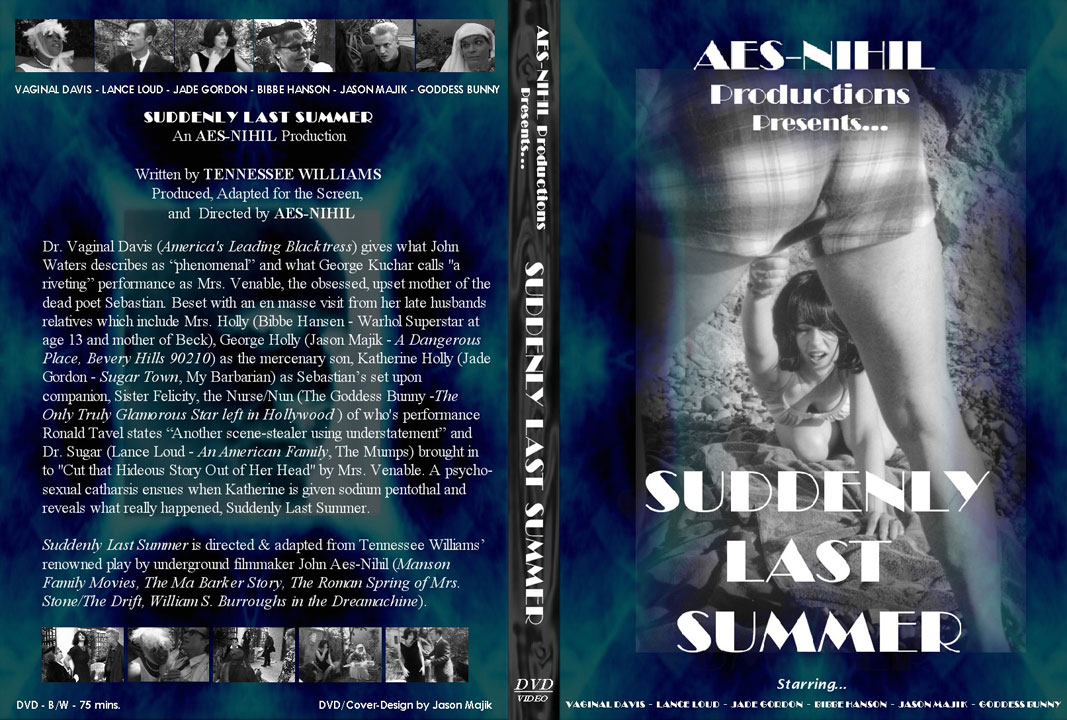
Suddenly Last Summer An Aes-Nihil Production
Second installment of the Aes-Nihil / Tennessee Williams trilogy, starring Jade Gordon, Bibbe Hansen, Vaginal Davis and Lance Loud.
"It's Fabulouse, I Love It! Vaginal's Performance is Phenominal!" John Waters
Dr. Vaginal Davis (America's Leading Blacktress) gives what John Waters describes as "phenomenal" and what George Kuchar calls "a riveting" performance as Mrs. Venable, the obsessed, upset mother of the dead poet Sebastian. Beset with an en masse visit from her late husbands relatives which include Mrs. Holly (Bibbe Hansen - Warhol Superstar at age 13 and mother of Beck), George Holly (Jason Majik - A Dangerous Place) as the mercenary son, Katherine Holly (Jade Gordon - Sugar Town, My Barbarian) as Sebastian's set upon companion, Sister Felicity, the Nurse/Nun (The Goddess Bunny -The Only Truly Glamorous Star left in Hollywood ) of who's performance Ronald Tavel states "Another scene-stealer using understatement" and Dr. Sugar (Lance Loud - An American Family, The Mumps) brought in to "Cut that Hideous Story Out of Her Head" by Mrs. Venable. A psycho-sexual catharsis ensues when Katherine is given sodium pentothal and reveals what really happened, Suddenly Last Summer.
Suddenly Last Summer is directed & adapted from Tennessee Williams' renowned play by underground filmmaker John Aes-Nihil (Manson Family Movies, The Ma Barker Story, The Roman Spring of Mrs. Stone/The Drift, William S. Burroughs in the Dreamachine).
------------
I feared that Aes-Nihil could not possibly transcend the original Manson Family Movie but I was incorrect. This film is uniquely entertaining and possibly the director's most impressive work to date. There is the signature obsession to detail that is typical of an Aes-nihil production but here it's transmuted into a kind of voyeuristic case study. We are also exposed to the fabulous Vaginal Davis. The combined talents of director and superstar performance is almost too much for the film to contain. The physical and emotional intensity of Davis is channeled into the Tennessee Williams adaptation resulting in a conceptual implosion. - Spiritual Terrorist
------------
The John Aes-Nihil film Suddenly Last Summer channels the wake of the Titanic: recognizable chunks of Tennessee Williams' original text, plot, and cast bob and float on a soundtrack of malice.
Organ music hums and whirs beneath Vaginal Davis, a big black man in a white dress humming along imposingly as Violet Venable (the mother of Sebastian, a dead young poet) and the organ swells and whines just as Jade Gordon, a white woman in a big black wig, swells and whines playing Catherine Holly, the distant cousin who was there to witness the young poet die. The score's connection to the action is ironic enough that one wonders if the organ really is the score to the movie or the leak from an ice-skating rink next door to the projection booth. The loudest sound in the movie – enough to make one jump -- is not the mighty Wurlitzer but the Waring Mixer chopping up the ice for five o'clock daiquiris.
Often the periphery of a given shot punctures what's being said or shown: in one sequence a chandelier crystal cuts down like a fang, in the extended opening sequence a boa sits coiled on Mrs. Venable's head dripping stray feathers over her eyes like white venom.
The actors, too, punctuate what's being said or shown. While Vaginal Davis beams, engorged by the sun, Lance Loud as Dr. Sugar circles her like a smiling pilot fish – listening as she proposes he perform a lobotomy on Catherine. Jason Majik as Catherine's handsome brother twirls his tennis racket as if drilling a hole in the camera. The Goddess Bunny has rarely looked so manly as she does in her white wimple playing Sister Felicity, Catherine's guardian.
The dead poet, Sebastian, appears a few times. In the body of the film he's played by Lawrence Elbert, in a sequence that closes the movie the role is done by David Organisek. Neither is particularly charismatic, or particularly good-looking. To ask what's the fuss is to miss the point. There IS a fuss, THAT is the point.
Bibbe Hansen's performance as Mrs. Holly (Catherine's mother) sums it up. Hansen is Diane Arbus-real – the role's any pretense to something other than artifice a pretense in itself. David Kaplan-Director: Tennessee Williams Theatre Festival
------------
Vaginal Davis, a major Los Angeles drag star, singer, stage performer, and DVD artist, dominates and intimidates all competition in Jon Aes-Nihil's SUDDENLY LAST SUMMER: a send-up and shrewdly perverse examination of Tennessee Williams' short story of the same name. Handling the talkathon role of Mrs Venable with supreme confidence (and memory), she takes quite seriously the role of a mother-in-law out to lobotomize her late son's wife, Catherine Holly – to prevent her from disclosing his use of them both as procurers - and his consequently being cannibalized.
In fact, one of the riveting aspects of this movie is watching the co-stars waiting for their chance to get a word in edgewise, trying to find their way around the cue that Vaginal Davis failed to drop, and defending themselves against her more-than-physical upstaging. Most martyred and long-suffering of these co-stars is the late Lance Loud (to whom the film is dedicated) who plays the less than enthusiastic Dr. Sugar, the surgeon hired to drill the hole in Catherine's forehead. He is several times crushed against Ms Davis' bosoms to prevent him from opening his yap, and on one occasion has to remind her of her own lines. Jade Gordon sedately handles the role of Catherine Holly, managing to capture the seductive look and postures of Liz Taylor (who essayed the part in the unsuccessful Hollywood version) minus Taylor's histrionics. Gordon also cleverly integrates her real-life patience into the character's near crushing circumstance. Another scene-stealer using understatement is The Goddess Bunny as Sister Felicity. Bibbe Hansen (who appeared in Warhol movies at age 13) plays the mercenary Mrs Holly and Jason Majik enacts her equally mercenary son, George. Handsome Lawrence Elbert and David Organasak both portray Sebastian. In a bit role as the nurse Miss Foxhill gingerly engineering Vaginal in a wheelchair, The Goddess Freya encapsulates what is so funny about all the performances. A pounding melodramatic score, humorously injected with the cries of flesh-eating birds, is provided by George Wright and Pharoah Sanders.
The choice of cannibalism for a subject has never been a lucky one for writers, and SUDDENLY LAST SUMMER was not Williams' only attempt to deal with it. Here, it is entirely unbelievable: and Jon Aes-Nihil, in hilariously dissecting its symbolism in Williams' story, is perhaps reminding us of the generally unbelievable material in Williams' opii, over and against their popularity. – Ronald Tavel, 2008.
------------
Film adaptations of Tennessee Williams' plays can be trying, especially for those of us lucky enough to have seen a well-rendered stage production. I attended the London premiere of a magnificent Suddenly, Last Summer production in 1999, with Sheila Gish as Mrs. Venable, Rachel Weisz as Catherine, and Gerard Butler as Doctor Cukrowicz.
And yet, miraculously, cult legend John Aes-Nihil re-articulates for film Williams' essential spirit and thanatos in this unexpected treasure. The cast more or less speaks for itself. Though Vaginal Davis is not quite as repulsive as I imagine Mrs. Venable to have become, this is after all a movie, and a well-paced Vaginal grows increasingly ghastly as the narrative unfolds—strong work on her part, as on the enigmatic director's. Shamanic is an apt word to describe her performance. The tragically departed Lance Loud (of "An American Family" fame), Jade Gordon, Jason Majik and Bibbe Hansen are predictably good.
Most of Williams' plays are forced to endure distorted endings at the hands of Hollywood—and, on first viewing, Aes-Nihil's Suddenly seems to uphold the tradition. It is, though, a subtle difference, and the subtlety is reinforced by an obvious aesthetic kinship. Unlike the cringe-inducing alterations imposed by earlier directors—on Streetcar, Cat, and both Suddenly predecessors—Aes-Nihil negotiates Suddenly's coda as a logic-defying enhancement, an unexpectedly quiet segue into seductive ambiguity. When asked, he explains that the book's low-key ending is anticlimactic (Dr. Sugar: "Maybe her story is true."), and ultimately anti-cinematic—it might have recalled the ending of the original Cat People.
Aes-Nihil's film develops in reverse, from the psychosexually open-ended closing moments at a paid public beach, and is accompanied throughout by an ardent devotee's selection of George Wright phonograph recordings. These theatre organ masterpieces are captivatingly well-suited, lending the film an effective means of time travel to a lost era of style, grit and fire, yet also an emotional resonance that protects this gem from the clutches of kitsch.
This is one of my favorite Tennessee Williams plays. Aes-Nihil's adaptation slots in right up there with the best. Well worth seeing! — David Woodard, Monopol
The second installment in director John Aes-Nihil's Tennessee Williams trilogy stands proudly ostracized from all modern independent endeavors. There is no question that Aes-Nihil went to great lengths to assemble a mesmerizing handful of actors and actresses, including Vaginal Davis, Bibbie Hanson, Jade Gordon, Lance Loud, Jason Majik, and The Goddess Bunny, who is undoubtedly, "the only truly glamorous star left in Hollywood." Vaginal Davis exhibits a wonderfully exaggerated performance as a mother grieving over the loss of her son who was a poet, struggling to maintain a sense of sanity when her deceased husband's relatives drop in for a visit. The story grows progressively stranger with each passing scene, and those who are familiar with the original play will be awe-striken by Aes-Nihil's extraordinary vision of the cast. It can also be said, without a moment of hesitation, that this is the only Tennessee Williams film adaptation to combines the erractic sounds of Pharaoh Sanders and George Wright. Recommended by John Waters, those interested in offbeat film won't want to miss it. — Scott Gabbey, Ultra Violence Magazine 2009.
------------
"Suddenly Last Summer is the second instalment in John Aes-Nihil’s trilogy of Tennessee Williams adaptations, the other titles being The Drift and Boom (which as far as I know is not currently available). Now, having never seen any of Williams’ original plays nor any of the numerous film and television adaptations myself, I can only judge his work from the interpretations of Mr. Aes-Nihil which, to say the least, are utmost bizarre.
The narrative centres on wealthy widow Violet Venable whose son Sebastian, a poet, has recently died while on vacation with his cousin Catharine. The film opens with a twenty minute monologue from Mrs. Venable addressed to a Dr. Sugar (aka Cukrowicz) endeavouring to convince him to perform a lobotomy on her niece in an attempt to stop her spreading the scandalous circumstances of her son’s death.
The rest of the film’s runtime is taken up with melodramatic bickering and familial in-fighting as Catharine’s mother and brother make an impromptu visit to the Venable estate hoping to snag some of the inheritance rumoured to be up for grabs. But when Dr. Sugar injects Catharine with truth serum, the fantastic reality of Sebastian’s death finally comes out and all illusions are shattered.
Shot on video in black-and-white with a cast consisting of - amongst others - drag queen / performance artist Vaginal Davis, Warhol star (and Beck’s mother) Bibbe Hansen, and Aes-Nihil regular the Goddess Bunny, Suddenly Last Summer invokes a warped vision of 1930s New Orleans where old rich widows are played by hulking black drag queens and Nuns by disabled transvestites.
As is typical with an Aes-Nihil production, all traditional notions of “acting” are thrown out the window in favour of overblown histrionics, unashamedly flubbed lines and just a general air of authenticity. This is filmmaking in the raw. If anyone could be credited with “stealing the show” it would undoubtedly have to be Ms./Mr. Vaginal Davis as his run-on monologues, screaming fits, wardrobe choices and scenery-chewing performance is just jaw-dropping and ultimately makes the film what it is.
Mention must be made of the soundtrack here, too, as it ranges from baroque organ music, free jazz saxophone and guitar to a high pitched drill-like effect that is explained away as the sounds of Mrs. Venable preparing her afternoon daiquiri (?!). Despite (or more likely because of) sounding slightly schizophrenic, a very effective score.
With its themes of incest, cannibalism and covert homosexuality, Suddenly Last Summer is the perfect vehicle to accommodate Aes-Nihil’s fetishistic attention to detail and outsider cinema perspective, thus works as one of the more interesting stage-to-screen adaptations I’ve had the pleasure of witnessing." - Rapeman, DVD Holocaust
------------
Finally graduating from the nauseatingly nostalgic true grit of VHS to digital video, sub-underground archivist, historian, and auteur John Aes-Nihil (Manson Family Movies, The Dreamachine Exhibition) would eventually complete the second film in his proposed Tennessee Williams trilogy (following The Drift and the mysterious Boom), Suddenly Last Summer (2008). As Mr. Aes-Nihil told me in an e-mail, the only reason the auteur got around to actually finishing (many of his films are ‘works-in-progress’ that take upwards of decades to complete) Suddenly Last Summer is so it could premiere at the Provincetown Tennessee Williams Theater Festival in Massachusetts where it was screened alongside Joseph L. Mankiewicz’s 1959 Hollywood adaptation of the same name starring Elizabeth Taylor and Katharine Hepburn, as well as the 1993 BBC Great Performances TV play starring Maggie Smith, Rob Lowe, and Natasha Richardson. Described lovingly by David Kaplan—the director of the Tennessee Williams Festival—as follows, “SUDDENLY LAST SUMMER channels the wake of the Titanic: recognizable chunks of Tennessee Williams' original text, plot, and cast bob and float on a soundtrack of malice,” Aes-Nihil’s recklessly wayward take on both Williams and Mankiewicz’s tale of fucked family matters turns its deadly serious source material(s) on its homo head and goes so far as to make a manically melodramatic mockery of death, cannibalism, mental illness, lobotomies, and scandalous family tragedy. Aberrantly adapted from the 1958 off-Broadway Williams play that was inspired by the poof playwright’s personal experiences, as well as the life of queer American poet Hart Crane (who committed suicide in 1932 at the age of 32 by jumping overboard on the steamship Orizaba after being beaten up for making homosexual advances to a heterosexual crew member of the ship) and various then-trendy psychoanalytic theories, Aes-Nihil’s Suddenly Last Summer is hysterical queen camp with the moral fortitude of an autistic transvestite toddler addicted to Ritalin and second rate Italian soap operas. Starring beyond beefy black tranny Vaginal Davis (Hustler White, The Lollipop Generation)—a meta-mensch of a perverse performance artist who has performed in bands with such charming names as ‘Black Fag’ and ‘The Afro Sisters’—in the decidedly diva role that Katharine Hepburn played in Mankiewicz’s adaptation, Suddenly Last Summer is the sort of film that could be used as aesthetic torture against about 6 billion people around the world, so it should be no surprise that John Waters stated of it, “It's Fabulous, I Love It! Vaginal's Performance is Phenomenal!” in what could not have been a more apt endorsement. The exceedingly bitchy and campy tale of a wealthy grief-stricken mother/widow who wants her niece-in-law to have a lobotomy so the truth about her gay poet son’s tragic death will never be revealed to the world, Suddenly Last Summer is probably the only film ever made where a queer Negro manages to pull off the role of a stinking rich white matriarch of the conspicuously cultivated and sinisterly scheming son-loving sort.
Venomous spade she-bitch Violet Venable (Dr. Vaginal Davis) is rather melancholy over the fact that her art-fag poet son Sebastian (portrayed by both Lawrence Elbert and David Organisek) will never write another poem again (during his short life, he would write a whopping single poem a year in between vacationing), but that does not stop her from being so disgustingly hateful as to plot to have her niece-in-law Catherine Holly (Jade Gordon) receive a lobotomy so as to hide the fact that her pretentious pansy progeny enjoyed engaging in mass orgies with dirty and uneducated proletarian boys. As is revealed in gay gossipy detail, twink sodomite Seb used to use his cousin Catherine as a means to lure men and since she knows he is a homo who died via ritualistic cannibalism, Mrs. Venable wants a piece of her brain pulled out of her niece’s pretty little head. Since her scheming mother Ms. Holly (lapsed Warhol superstar Bibbe Hansen, who is probably best known as the mother of musician Beck) and greedy philistine brother George Holly (Jason Majik) stand to receive $500,000 from Mrs. Venable as a reward for her lobotomy, Catherine really has very little choice about whether a piece of her grey matter will be drilled out of her thick skull or not. Venable has hired a small fellow named Dr. Sugar (his real name is ‘Cukrowicz’, which is Polish for ‘sugar’) played by Lance Loud (who died long before the film was released in 2001 and to whom the work is dedicated) to examine Catherine and see if she is worthy of doctor-approved brain damage. While waiting for a date with the doc at a mental institution, Catherine burns a sassy nurse/nun named Sister Felicity (played by the Goddess Bunny in what is easily the paraplegic tranny’s most butch film role) with cigarettes. After stating, “I am going to give you a simple injection of the truth…whether you like it or not” and giving Catherine an injection of some good phamarcy grade smack, Dr. Sugar learns that Saint Sebastian was a scheming sodomite who took his cousin to Europe and treated her to a lavish vacation of decadence, but whose generosity was merely a ploy to con his relative into carrying out dirty deeds for him. Indeed, Sebastian forced his little cousin to wear scandalous curve-exposing bathing suits to capture the attention of young men, so he could later defile them. Before using Catherine to procure prole peckers, Seb the sod also used his unwitting mother, who never in a million years would consider that her little baby boy was a debauched boy-buggerer. One day, while on vacation with Catherine, Sebastian was worshipped as a god by a horde of young boys who got so horny and hungry that they killed and cannibalized the poet in a Dahmer-esque fashion. In the end, Catherine and Sebastian’s beachside rendezvous are pseudo-sentimentally recalled in preposterous detail. Undoubtedly, I found it hard to cry about the fact that suddenly last summer a sod of a poet who wrote one poem a year was devoured by a perverted pack of brown boys, thus resulting in the end of pretentious poetry for Violet Venable.
While I must admit that I discovered more delightful aesthetic debasement and diva derangement in director John Aes-Nihil’s previous Tennessee Williams adaptation The Drift (1989), Suddenly Last Summer still has enough post-postmodern trashcan camp to wet the panties of 101 attention-starved white trash tranny junkies from Southern California. Indeed, while big and bombastic blacktress Vaginal Davis lacks the handicapped homo glamour of thee Goddess Bunny, he certainly lent a certain untamed energy to the role of Violet Venable that reminds one why Katharine Hepburn is one of the most absurdly annoying, uniquely unfeminine, and outrageously overrated queen bitches to be shat out the kosher gloryhole that is holy-wood. After watching Suddenly Last Summer back-to-back with Mankiewicz’s dark 1959 melodrama starring Hepburn and Elizabeth Taylor, I can safely say that Aes-Nihil did an innately iconoclastic job reducing a Hollywood classic to the level of an off-off-off-Broadway drag show that would even make gay gutter-auteur Andy Milligan gawk in abject disgust. A sardonically sordid story about a scattered-brained queer-cousin-loving dame who fails to “cut that HIDEOUS STORY out of her head” after taking a narcotic-filled needle in her arm and vomiting the quasi-spiritual event where her cocksucking megalomaniac cousin was eaten by a tribe of cannibalistic twinks, Aes-Nihil’s Suddenly Last Summer ultimately reveals with its strikingly simplistic style of storytelling that Tennessee Williams essentially wrote pumped up poof pulp trash in play form. If you ever wondered if Katharine Hepburn was less feminine than a black drag queen and/or if Tennessee Williams has anything in common with John Waters aside being effortlessly effete, Suddenly Last Summer is certainly a work that answers a number of life's many mysteries, albeit in a manner that personifies delusional dollar store glamour that only can be found in the modern day Sodom that is sunny Southern California. —SoiledSinema.com
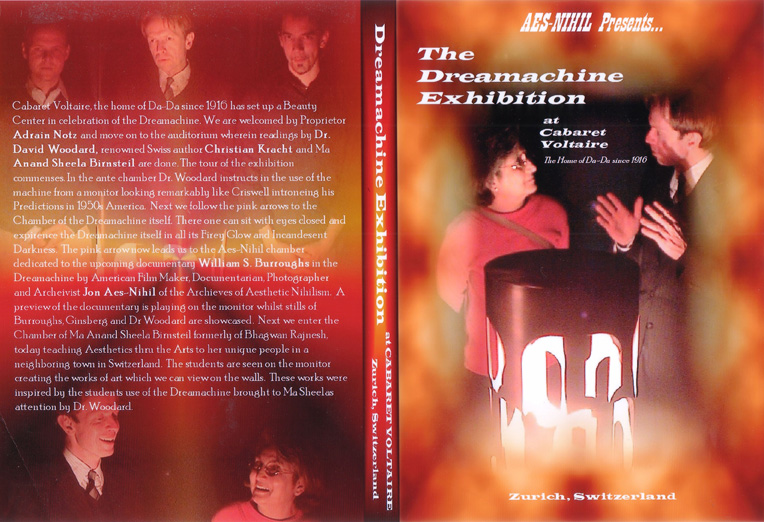
DREAMACHINE EXHIBITION AT CABARET VOLTAIRE ZURICH - The Dreamachine is a stroboscopic apparatus that when sat in front of with the eyes closed induces a hallucinogenic, hypnagogic state. It was invented in the ‘60s by Beat writer/poet Brion Gysin with the help of Ian Sommerville after being inspired by W. Grey Walter’s book, The Living Brain. William Burroughs had long been an advocate of the machine and helped it gain more widespread attention.
The Dreamachine Exhibition documents the 2008 installation at Cabaret Voltaire in Zurich, birthplace of the Dada movement. The feature speaker at the presentation is Dr. David Woodard, who, after corresponding with Burroughs in the ‘90s tweaked and perfected the Dreamachine, subsequently constructing models for celebrities such as Kurt Cobain and Iggy Pop. The other guest speakers include Swiss author Christian Kracht and infamous “cult” personality Ma Anand Sheela.
After readings from Dr. David Woodard and Christian Kracht (whose ode to the elegant aesthetics of Japanese toilets is most charming), Ma Sheela speaks about her art therapy with mental health patients incorporating the Dreamachine. Then the floor is opened for a short Q&A in which Dr. David Woodard expounds on the history of the Dreamachine and its uses.
Afterwards we are taken on a tour of the actual exhibition which includes a video introduction to the Dreamachine by Dr. David Woodard, photo documentation of Ma Sheela and her patients interacting with the machine and some of their artworks, a preview of Jon Aes-Nihil’s upcoming documentary William S. Burroughs and the Dreamachine, and a darkroom housing the machine where observers are able to experience it for themselves.
For an 83 minute film purely documenting the Dreamachine Exhibition, this is surprisingly fascinating viewing. Admittedly the opening readings could be considered a little dry for home spectators, but once the exhibition is opened up things get more stimulating. The most interesting segment for me personally was the excerpt from the Burroughs documentary, as it showcases the aged junky shuffling about his house wrapped in an old army coat tending to his kitties, preparing his drink of choice - Vodka ‘n’ Coke, and chatting with Dr. David Woodard and Aes-Nihil on the subjects of hallucinogens and L. Ron Hubbard. Recommended viewing for Beat fanatics and transcendental enthusiasts alike. - Rapeman July 29 2010
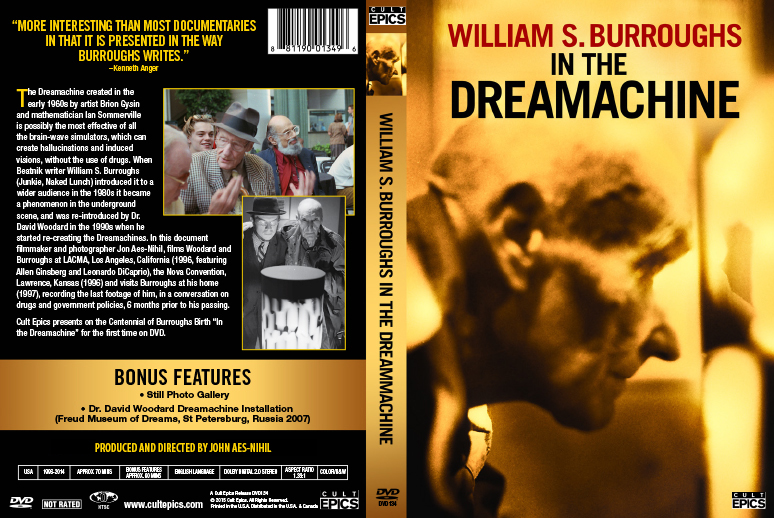
William S. Burroughs In The Dreamachine An Aes-Nihil Production
The Dreamachine created in the early 1960s by artist Brion Gysin and mathematician Ian Sommerville is possibly the most effective of all the brain-wave simulators, which can create hallucinations and induced visions, without the use of drugs. When Beatnik writer William S. Burroughs (Junkie, Naked Lunch) introduced it to a wider audience in the 1980s it became a phenomenon in the underground scene, and was re-introduced by Dr.David Woodard in the 1990s when he started re-creating the Dreamachines. In this document filmmaker and photographer Jon Aes-Nihil, films Woodard and Burroughs at LACMA, Los Angeles, California (1996, featuring Allen Ginsberg and Leonardo DiCaprio), the Nova Convention, Lawrence, Kansas (1996) and visits Burroughs at his home(1997), recording the last footage of him, in a conversation on drugs and government policies, 6 months prior to his passing. Cult Epics presents on the Centennial of Burroughs Birth “In the Dreamachine” for the first time on DVD.
------------------------------------------
In truth, and for those that are not in the know, we should "paint a picture" of the man in question first: William S. Burroughs, one of the three seminal writers of the Beat Generation (the other two being his friends Jack Kerouac and Allen Ginsberg), was born in St. Louis, Missouri, on February 5, 1914, to the son of the founder of the Burroughs Adding Machine Co. He grew up in patrician surroundings and attended private school in Los Alamos, New Mexico, chosen due to the climate as he suffered from sinus trouble (the school was later used to house the Manhattan Project during World War II)).
Burroughs took his undergraduate degree at Harvard College (Class of 1936) but rebelled inwardly against the life that the upper-class Harvard man was supposed to lead during the pre-war period (outwardly he dressed the part of a patrician, with three-piece suit, necktie, black homburg and chesterfield overcoat being his standard wardrobe. His political options generally were also of his class, i.e., right-wing).
Planning to become a physician, Burroughs moved to Germany to study medicine. The plight of the Jews under the Nazis was desperate, and in 1937 Burroughs agreed to marry Ilse Herzfeld Klapper, a German Jewish woman, so she could leave Germany and eventually become a U.S. citizen. The two remained friends for many years after they moved back to the U.S., meeting often for lunch when Burroughs eventually settled in New York City in the early 1940s. They never lived together, and Burroughs formally divorced her in 1946 so he could marry his second wife, Joan.
Perhaps it was his exposure to National Socialism in Adolf Hitler's Germany that raised Burroughs' interest in his lifelong fascination: control mechanisms used by the state against its citizens. Burroughs left Germany for the United States without completing his studies, bringing along Ilse.
The rest, including him being a homosexual in an extremely homophobic age, is history, as they say, but here in 'William S. Burroughs In The Dreamachine' we witness a fascinating documentary about the Dreamachine's invention in 1959 by poet Brion Gysin and mathematician Ian Sommerville. Possibly the most effective of all brainwave simulators, triggering mental aberrations that are comparable to drug intoxication or dreaming, writer William S. Burroughs (Naked Lunch) introduced the Dreamachine to a wider audience through interviews in the 1970s and '80s.
The idea of the machine became an counterculture sensation, but it wasn't until the mid-'80s, when David Woodard began fabricating Dreamachines, that it became a phenomenon. Watch this documentary today and you will never be the same person again! This is a Widescreen Presentation (1.85:1) enhanced for 16x9 TVs and comes with the Special Features of: Dr. David Woodward Dreamachine Installation (Freud Museum of Dreams, St. Petersberg, Russia 2007
------------------------------------------
The dreamachine is a brainwave simulator created in the 1960s by artist Brion Gysin and mathematician Ian Sommerville. It’s a tubular machine which spins and distributes flickers of light that can induce visual hallucinations without the user having to ingest fistfuls of mind-altering substances. The dream flicker phenomenon, which is explained in great detail by Dr. David Woodard, dates back to the days of Nostradamus. It has been utilized throughout history by artists and gurus interested in experimenting with altered states of consciousness. One of the most notable figures of this movement is William S. Burroughs, the prolific writer and self-proclaimed junkie, who brought us the novel Naked Lunch and was accurately described in 1962 by Norman Mailer as being “the only American novelist living today who may conceivably be possessed by genius.”
In the late 1990s, director and photographer Jon Aes-Nihil set out to document Burroughs’ involvement with the dreamachine. The collected footage is divided into sections which include Burroughs’ appearance at the L.A. County Art Museum Show in 1996, the Nova Convention in Lawrence, Kansas, and an intimate conversation at his home in 1997, which is the last known footage of the writer, taped only a few months prior to his death.
Jon Aes-Nihil’s approach to the documentary is artistically atypical. Cult director Kenneth Anger explains, “It is more interesting than most documentaries in that it is presented in the way Burroughs writes.” Instead of interviewing a parade of celebrities, or using a montage of already seen photographs, the footage is edited in a way that is personal and interactive. The viewer is standing at his table at the show in L.A., or in his living room having a casual conversation, while the dreamachine that was gifted to him by Dr. Woodard, spins in the background.
Aside from the unique footage that most fans of the writer will certainly enjoy, this is a history lesson of the dreamachine. There is an equal amount of footage of Dr. Woodard discussing the background of the machine, documented in various locations, such as alongside Highway 666 in New Mexico. It’s just off of the Devil’s Highway that Aes-Nihil takes us inside a tiny workshop where we witness Dr. Woodard at work on one of his models. This serves as a tutorial for those who might be interested in constructing and experimenting with the dream flicker phenomenon.
Presented by Cult Epics, the DVD also features a lecture given in 2007 by Dr. Woodard at the Freud Museum of Dreams in St. Petersburg, Russia, and a rare collection of photographs taken by Aes-Nihil. Highly recommended. –Scott Gabbey, Cult Epics 2015
,
Descent Into Glamour
The Goddess Bunny story, starring
the Goddess Bunny, Jade Gordon and Vaginal Davis.
AUDIO CDs
Beyound
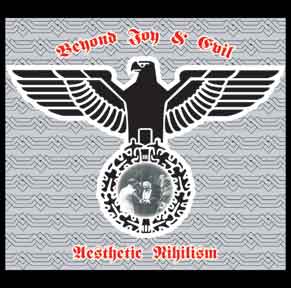
Joy And Evil Does Aesthetic Nihilism, 1974-79
Avant-garde heavyweights play on rock instruments with regard
for nothing but energy. Includes: What Have You Done for
Your Führer Today?, Accurately Killing, Something As It
Really Is, Beyound Joy and Evil, Jeanne Maureen, and Beyond
PCP Live. Lyrics by Nietzsche, C.S. Lewis, Mel Lyman and
others. "Sort of like Metal Machine Music, but with lyrics."
Lyric book included. (70 min.) DOUBLE CD $20
The
Ma Barker Story Soundtrack & Compilation, by
Glen Meadmore, Ed Keller, Dan Janish and Aric Leavitt
CD $15.00.
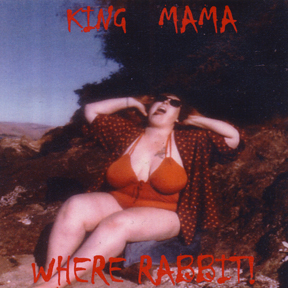
King Mama Does "Where Rabbit?"(X)
A giant, perverse male hawg trapped in a female human body.
King Mama says, "I am the best... buy my tape or I'll kill
you." King Mama Comix included. (60 min.) CD & ComiX $25.00.
Boy Tito M... Bisexual Punk
The psycho-sexual rantings of a 7-year-old depraved genius.
(60 min.) CD and The God Book $25
MAGAZINES
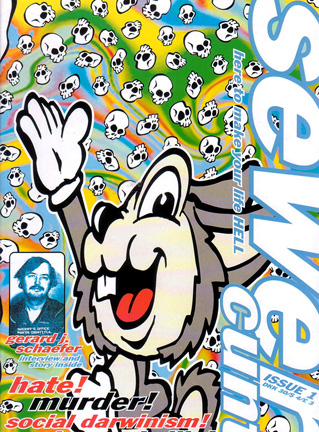
Sewer Cunt
Transgressive magazine from Scandinavia. It has an interview with Aes-Nihil. Its along the lines of Answer Me. Sverre Kristensen, Nikolas Schreck & Nick Bougas are also interviewed $25